Without adding staff or clinic hours, in the first four months since go-live, Monument Health reached…
In a Nutshell
Based in Rapid City, South Dakota, Monument Health is a trusted health system serving patients across a largely rural geographic area, where access to specialty care is limited. When Monument launched Care Connect, their initiative to modernize patient access across the system, they partnered with Hummingbird Healthcare to help turn their vision into operational reality.
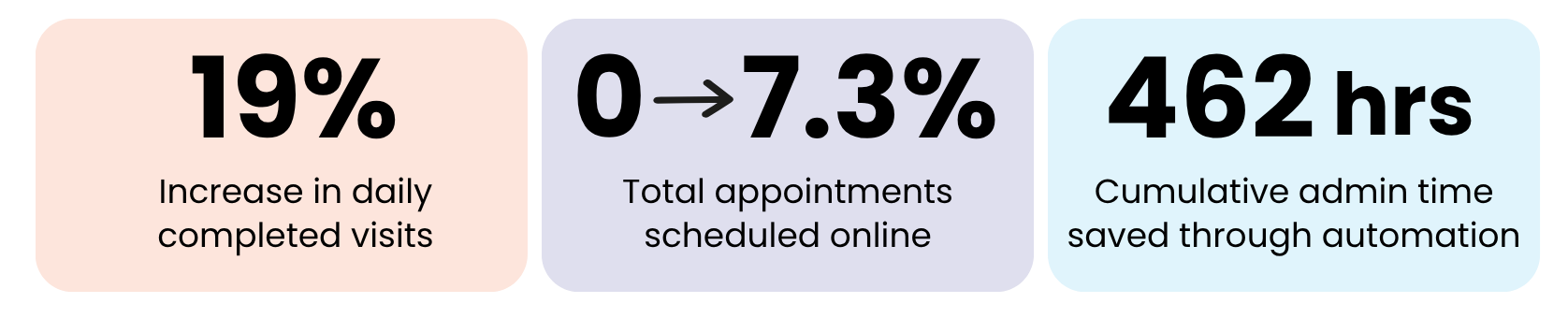
The access transformation results in Cardiology proved what’s possible and built the foundation for what’s to come. In the first four months, without adding providers or clinic hours, completed daily visits grew by 19%, online scheduling grew from 0% to 7.3%, and provider utilization is approaching 100% across MDs and APPs.
This added capacity was already available in Monument’s Epic environment and their existing team of staff and providers. The unlock was having an accountable partner in technology transformation, process redesign, and operational standards to turn their latent capacity into care.
The Challenge
Monument’s scheduling infrastructure had grown organically over the years, but it wasn’t keeping pace with patient expectations or organizational capabilities. Online scheduling was available for primary care and select radiology areas, but not broadly activated. When appointment slots opened, or follow-ups were needed, staff handled everything by phone and mail. There were manual touchpoints at every step.
Referrals moved through processes that consumed staff time without adding clinical value. Lacking real-time visibility into schedule performance, there was no clear picture of where the friction lived or how to fix it.
The building blocks for modernizing access were already there in Monument’s team and Epic system. The opportunity was to develop a foundation for consistent access standards across the system and activate Epic’s full capabilities, reducing administrative burden through automation.
The Solution
Rather than diving in with quick fixes in a single department, Hummingbird’s deliberate approach began with building the enterprise access foundation, making every department that follows easier to activate and progress harder to erode. The foundation was built through establishing scheduling standards, template architecture, and governance infrastructure at the enterprise level. From there, operational work at the specialty level began.
Hummingbird and Monument chose Cardiology as the first department to activate because it’s one of the most complex scheduling environments in any health system. If the model worked there, it would work anywhere. The team:
- Optimized and rebuilt provider scheduling templates.
- Activated online scheduling for patients.
- Redesigned referral order workflows to reduce manual touchpoints and route the right patient to the right provider.
- Deployed waitlist automation to prevent unused capacity from slipping away.
Additionally, Hummingbird’s Mission Control, an embedded operating model centered on access adherence, gave Monument real-time visibility into online scheduling rates, no-show and late cancel trends, referral turnaround times, provider and schedule utilization, and visit volume. Even more importantly, Mission Control provides proposed interventions to prevent backslide, ensuring results compound after go-live instead of drifting back to baseline.
Throughout, Hummingbird worked alongside Monument’s operational leaders to understand their challenges firsthand, developing the workflows, processes, and tools to help their teams work more efficiently and accurately. Hummingbird also partnered closely with Monument’s IT team to optimize and refine their Epic environment for both current needs and what comes next.
The Results
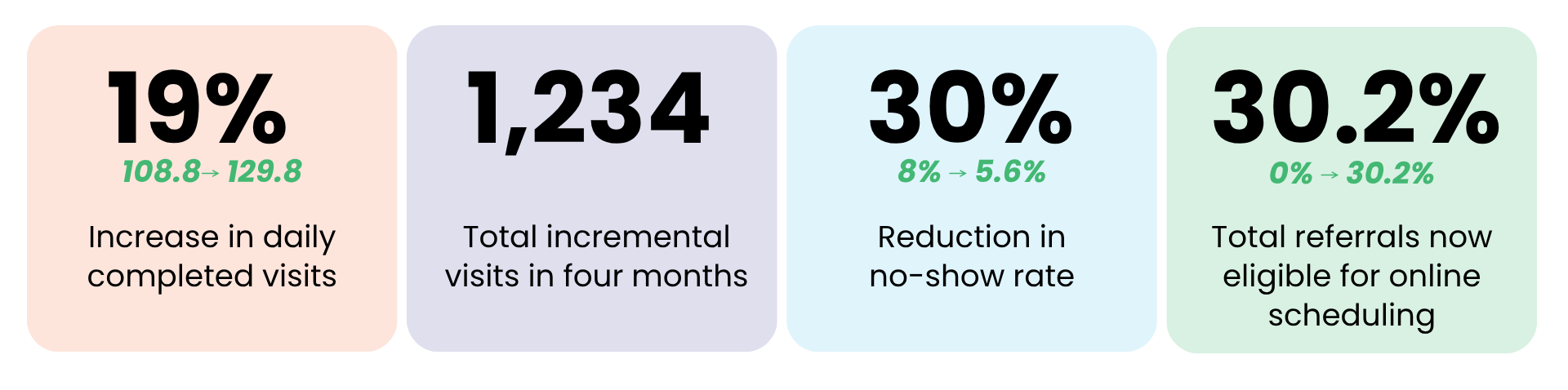
Four months in, Cardiology is running well above every target, and results continue to build each month. Daily completed visits have climbed from 108.8 to 129.8, a 19% increase driven by better template utilization, smarter provider-to-patient matching, and fewer no-shows. The same providers and the same staff are now working within a system built to deploy their capacity effectively.
Online scheduling grew from 0% to 7.3%, as patients began self-scheduling, cancelling, and rescheduling without a phone call. This saves staff time on every interaction, reduces call abandonment rates, and makes access easier for patients who can’t call during business hours. The no-show rate fell 30%, from 8.0% to 5.6%. And in May, Cardiology hit the 30% referral ticket rate project benchmark for the first time resulting in one in three referrals now being eligible for online scheduling.
Behind the scenes, automation recovered 462 cumulative hours of administrative work across ticket notifications, follow-up order requests, triage outreach, and referral clearance. That’s time back to staff for higher value tasks.
What’s Next
The enterprise access infrastructure built during the Cardiology engagement provides the foundation for Monument’s Care Connect initiative to scale. Every department that follows is faster to activate and more consistent from day one.
Endocrinology is already live, and Primary Care is in motion. From there, the roadmap extends across Monument’s remaining medical and surgical specialties, along with imaging workflows, ultimately touching every part of how patients access care across the system.
When that work is complete, Monument will have a unified patient access experience built on shared standards and sustained by real-time data. The Care Connect program is not a one-time intervention that drifts back to baseline. It’s change that sticks for good.